
TM


Why Generator Coolant is Different from Automotive Coolant
Engineered for Different Operating Environments
At first glance, coolant is simply a liquid that regulates engine temperature. However, diesel generator coolant and automotive engine coolant are designed for fundamentally different applications. Although both transfer heat and help prevent corrosion, the operating conditions of a diesel generator (Genset) are significantly different from those of a passenger vehicle.
A generator may operate continuously for long durations under a constant heavy load or remain on standby for weeks before starting instantly during a power outage. Passenger vehicles, on the other hand, experience variable loads, frequent stop-start cycles, and regular driving conditions.
For these reasons, a generator coolant requires a specialized formulation that provides long-term thermal stability, corrosion protection, cavitation resistance, and reliable performance under industrial operating conditions.
Continuous Heavy-Duty Operation vs. Variable Driving Conditions
Diesel Generators Operate Under Constant Load
Industrial generators are designed to deliver uninterrupted electrical power for hospitals, manufacturing facilities, telecom towers, commercial buildings, construction sites, and data centers. During operation, they often run for several hours—or even days—at a nearly constant load.
This creates sustained thermal stress on the engine and cooling system. A diesel generator coolant must therefore maintain stable heat transfer properties throughout prolonged operation without degrading or losing effectiveness.
Automotive Engines Operate Differently
Passenger vehicles experience changing engine speeds, acceleration, deceleration, idling, and frequent stop-start conditions. Their cooling systems are optimized for rapidly changing temperatures rather than continuous industrial workloads.

Wet Cylinder Liners Require Specialized Protection
One of the biggest engineering differences between many industrial diesel engines and passenger vehicle engines is the use of wet cylinder liners.
In generator engines, coolant comes into direct contact with the outer surface of the cylinder liner. Continuous engine vibration can create microscopic vapor bubbles that collapse against the liner surface—a phenomenon known as cavitation.
If left unchecked, cavitation can gradually erode the liner, leading to coolant leakage, reduced engine efficiency, and costly repairs.
A high-quality generator coolant is formulated to help protect against:
-
Cavitation erosion
-
Corrosion
-
Pitting
-
Scale formation
-
Premature liner wear
Most passenger vehicles use dry-liner or monoblock engine designs, where this type of protection is generally less critical.
Protection During Long Standby Periods
Unlike automobiles that are driven regularly, many generators remain idle for extended periods while waiting for an emergency power failure or scheduled operation.
During these standby periods, moisture, oxygen, and contaminants can contribute to internal corrosion if the cooling system is not adequately protected.
A dedicated diesel generator coolant helps preserve the cooling system by maintaining corrosion inhibitors even during prolonged inactivity, ensuring the generator is ready to perform immediately when required.

Built for Real-World Industrial Conditions
Generators are often installed in remote locations where maintenance conditions differ from those of automotive workshops.
Examples include:
-
Manufacturing plants
-
Telecom towers
-
Construction sites
-
Mining operations
-
Hospitals
-
Commercial buildings
-
Rural installations
In many cases, top-ups may be performed using locally available water, making coolant stability even more important.
Industrial-grade coolant formulations are designed with these practical field conditions in mind, helping reduce deposits, scaling, and corrosion within the cooling system.
Protection for Mixed Metal Cooling Systems
Industrial diesel generators commonly use cooling systems made from a combination of materials, including:
-
Cast iron
-
Copper
-
Brass
-
Steel
-
Aluminum alloys
Each material reacts differently to heat, moisture, and chemical exposure.
A premium generator coolant is formulated to provide balanced corrosion protection across these mixed-metal cooling systems, helping extend the service life of radiators, pumps, cylinder liners, and engine components.
Automotive coolants are typically optimized for modern passenger vehicle cooling systems that predominantly use aluminum components.
Designed for Industrial Emission Standards
Generator engines are engineered to comply with industrial emission regulations and OEM cooling system requirements.
A dedicated diesel generator coolant is developed to support the operational needs of these engines, ensuring reliable cooling performance under demanding industrial applications while aligning with applicable generator specifications.
Using a coolant designed specifically for diesel generators helps maintain cooling efficiency and supports long-term engine reliability
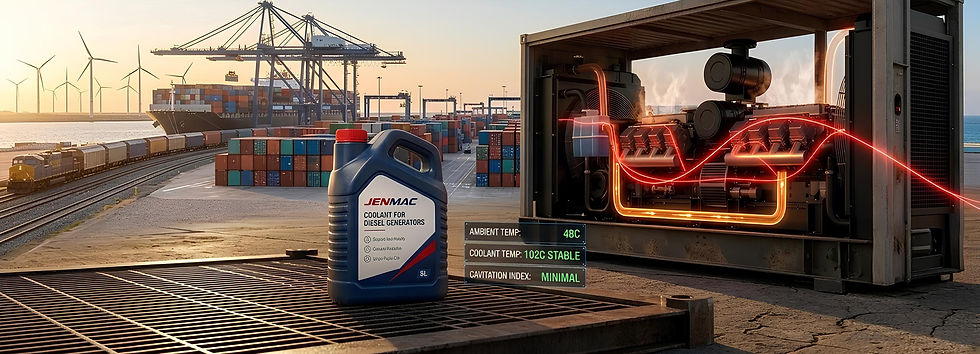
Why Choose JENMAC Diesel Generator Coolant?
JENMAC Diesel Generator Coolant has been developed specifically for the operating conditions of CPCB IV+ diesel generators. Its advanced formulation is engineered to deliver:
-
Superior heat transfer for efficient engine cooling
-
Protection against corrosion and cavitation
-
Reliable performance during extended operation
-
Long-term protection during standby periods
-
Compatibility with mixed-metal cooling systems
-
Extended engine life with reduced maintenance
Whether your generator powers a hospital, manufacturing plant, data center, telecom site, or commercial facility, JENMAC Diesel Generator Coolant is engineered to provide dependable cooling performance where reliability matters most.